
As a resident of Western North Carolina (WNC) working in community and economic development, I have come to know and understand the many unique challenges that both residents and small businesses face, such as the land and unique mountainous terrain, the price and lack of affordable housing, the lack of childcare and affordable childcare, and the cost of living to name a few. I acknowledge that many of these challenges are not unique to WNC and can be universally applied to the country.
So, let me try to paint you a picture of WNC. Most of it is rural, with small populations in each county and municipality that heavily rely on small businesses and tourism to support local economies.
Regardless of the size of some communities, 45% of North Carolina’s GDP comes from Western North Carolina (OSBM Helene Damage Assessment), and 99.6% of North Carolina’s GDP comes from small business owners.
https://www.osbm.nc.gov/hurricane-helene-dna/open
The months of September and October are classified as “peak leaf season,” as many tourists flock to the area to witness the spectacular seasonal change of the trees that fills mountains and hillsides with bright colors of yellow, orange, and red. These tourists typically provide small business owners with about 30% of their annual revenue, enough to sustain them during the slower winter months until tourism picks up again during the spring. There is much more relevance to this, and I’ll get into it further.
There are a total of 100 counties in North Carolina that are rated on a 3-level tier system. Most of WNC is also classified as distressed in accordance with the state’s rating system, which can be found here: https://www.commerce.nc.gov/grants-incentives/county-distress-rankings-tiers
The median income is below the state’s median income of $68,610, and we have a higher population of seniors than the state, requiring a high level of care. For more in-depth details, please feel free to explore this county profile map put together by the NC Rural Center: https://www.ncruralcenter.org/county-data/
Thinking back to late September of 2024, I don’t think anyone could have predicted the magnitude or the impact that Tropical Storm (TS) Helene would have in our region.
I was extremely fortunate, thankful, and grateful to have escaped the storm with no damage other than food loss. Thinking back to that day, I recall being home on Friday, September 27, and the power went out at about 8:00 am. Many parts of Western North Carolina had already received 6-10 inches of rain the day before the implications of TS Helene, which set the stage for the disastrous events that followed. The ground became over-saturated with water from a different storm system the day before, and the surrounding bodies of water had already risen or flooded.
I was calm when the power went out. I thought I was prepared and ready. I was not. No one was. No amount of warning could have prepared the citizens of the disaster-declared counties for what was to come. Shortly after the power went out, all cell phone communication was lost, and there was no internet access. I was in the dark, literally and figuratively. Having no idea what was happening and inability to find out sent me into panic mode. I made preparations to leave until it was suitable to come back, which ended up being almost 3 weeks later when the electricity was restored.
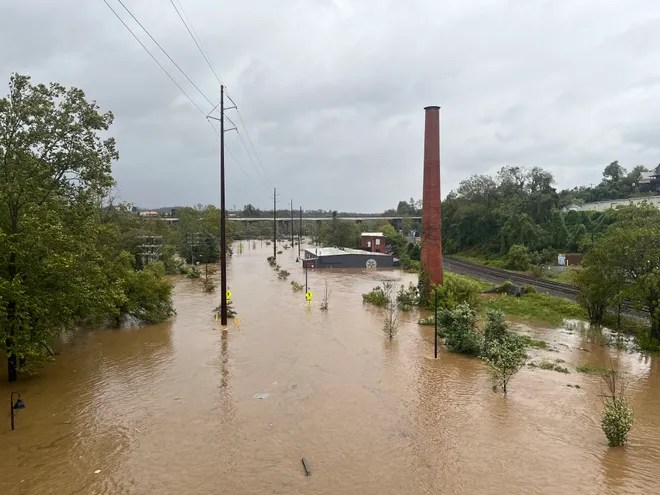
I remember waking up early on Saturday, loading my car, and heading out into the unknown. A typical 3-hour drive took almost 6 hours, and I had to drive well over 120 miles before I could get a glimmer of cell phone reception. Every small town that I drove through was also without electricity. Homes were ravaged and destroyed, and I witnessed the entire River Arts District underwater while driving out of Asheville. I saw homes and vehicles with trees lying across them. I saw a whole section of the interstate closed from a mudslide in Black Mountain, which caused a reroute from 70 to 26 for myself and many others trying to leave the city. I saw people, blanked-faced, wandering the streets in a state of panic and confusion, trying to figure out where to go or what to do. It was the equivalent of the zombie apocalypse minus the zombies. I don’t know how else to explain it.
I watched the chaos unfold from afar and kept my neighbors and friends up-to-date as much as I could via text messages who had chosen to stay in their homes but did not have internet access. Leaving my home left me with a feeling of guilt, but I soon realized that I was one less person in the area to take away from the resources that were desperately needed by those who had lost everything.
Here is a view of what I saw driving out of Asheville on Saturday, the 28th. The French Broad River reached over 16 feet by 11 am covering most of the River Arts District, seen here from the Haywood Road bridge. Photo Source: Jacob Biba/Asheville Citizen-Times: https://www.citizen-times.com/picture-gallery/news/local/2024/09/29/river-arts-district-asheville-flooding/75442009007/
WNC communities and small businesses were and are still recovering from TS Fred, in addition to small businesses recovering from the COVID-19 global pandemic before TS Helene hit. Most of Fred’s public recovery efforts have been wrapped into the scope of TS Helene’s recovery efforts. Public recovery is a challenge but not the same as private business recovery.
Private business recovery differs significantly from public recovery because business owners assume 100% of the risk. There are few options for small business owners (SBOs) outside of loans or grants (if they can find any). Many SBOs are still paying off loans that supported them throughout the pandemic and cannot borrow more money regardless of the low interest rates offered by the Small Business Administration.
So, what was the first problem? As I said before, small businesses earn approximately 30% of their annual revenue during September and October, peak leaf season. The revenue earned during peak leaf season carries SBOs to spring when tourism picks up again. Just because communities were located in disaster-declared counties does not equate to them being closed for business. They had the capacity to handle economic activities derived from tourism.
The former Governor of North Carolina, Roy Cooper, declared WNC closed for business and announced to tourists, “We don’t want you here.” Naturally, people stopped coming. https://www.citizen-times.com/story/news/local/2024/10/03/nc-gov-cooper-to-tourists-after-helene-we-dont-want-you-here/75494195007/
I understand the implications that were caused to all of the roads in Western North Carolina and the need for roadways to be free for emergency responders and trucks bringing in aid. Still, at the same time, small, rural, distressed communities that were not impacted or minimally impacted that could host tourists were unintentionally crippled through the actions of the former Governor. The intentions were good, but the delivery was terrible and should have been much more precise regarding what was closed to tourism and who was open.
What’s the second problem? At the time, the Small Business Administration (SBA) ran out of funds for the year and could not provide disaster relief loans in a timely manner. https://www.sba.gov/article/2024/10/15/sba-exhausts-funds-new-disaster-loans
So, let’s say a business owner filed an insurance claim, and like most insurance claims, there was a partial or complete denial. Now, the business owner turns to the SBA, and there is no money. What are they supposed to do? The harsh reality is that many had to close their shops, pack up, and leave the state. Their employees and the owners are out of work, the local economy is affected, and the entirety of North Carolina is affected.
Thanks for stopping by The Professional Student! Part 2 will follow shortly, but please let me know your thoughts, especially if you’re a local resident of Western North Carolina.
 Innovative Leadership and Entrepreneurship: From Grad Student to Graduated
You must be logged in to post a comment.