
Shawn Smallwood, ME
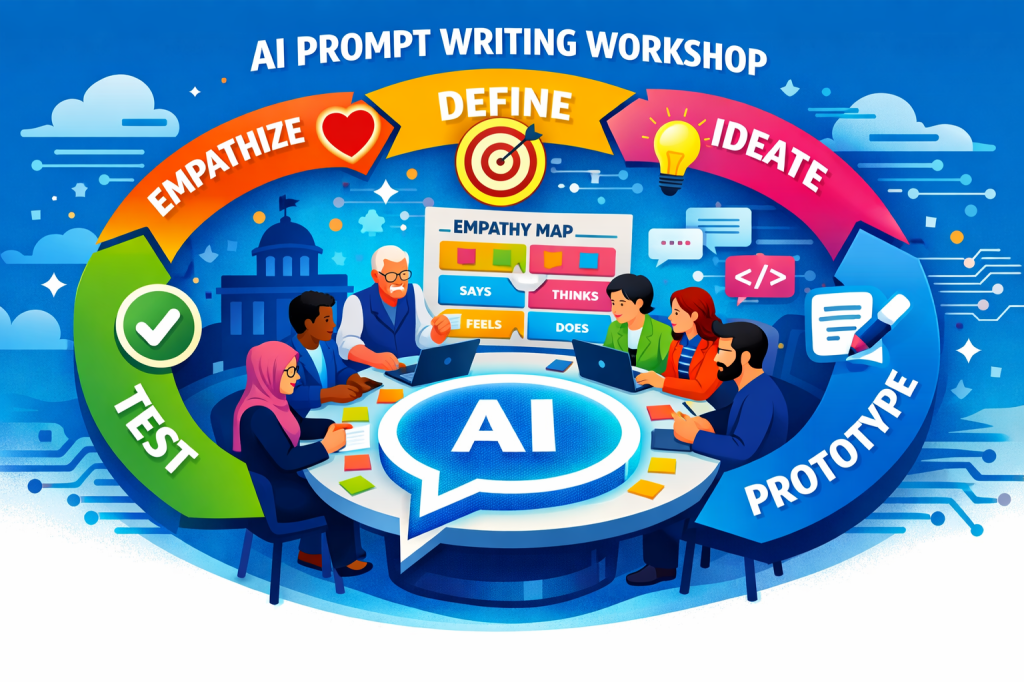
I was first introduced to design thinking during my undergraduate school, and then again during my master’s program. In my master’s program, I was challenged to design a class or workshop that uses design thinking to teach design thinking. The topic was left to us, so I chose AI prompt writing and the ethical and responsible use of AI in public administration. The use and ethical use of AI in public administration are relevant topics that can be difficult to define. Regardless of industry, who’s to say how well-versed anyone is in even finding a starting point for using AI?
I’ve never put together a detailed, scripted, and well-organized workshop complete with equipment and materials before, and boy! What appreciation I have for those who are charged with training and development. At first, I thought my workshop needed flashier slides or trendier buzzwords. During the process, I discovered that the real magic lies in design thinking, a human-centered approach that turns a routine “how-to” session into an inspiring, collaborative experience. Here’s how weaving empathy, iteration, and creativity through every stage reshapes the “AI Prompt Writing” workshop, and how you can apply the same principles to any class or seminar.
I’m not going to give you my fully developed workshop, but I will give you the building blocks to develop your own, regardless of the topic. You can apply these principles universally.
Setting the Scene: From Lecture to Co-Creation
Rather than opening with a traditional lecture, participants can begin by stepping into each other’s shoes. By using a quick pre-session survey to ask about past experiences with AI tools and the frustrations encountered, a unique story can emerge. Things that might be learned about the group could include:
- A seasoned planner anxious about jargon
- A tech-savvy analyst eager to explore new use cases
- A team lead uncertain about ethical pitfalls
By mapping these emotional highs and lows, the stage can be set for a workshop that speaks directly to the real people in the room, not just hypothetical learners. There is no “one size fits all,” which equates to a unique and new experience with every workshop iteration.
Act I: Empathize & Define — Framing the Challenge
On the morning of the workshop, each table receives sticky notes and storytelling prompts. Next, participants break up into small, cross-generational groups. Participants can then share a “moment of AI confusion” and stick their key insights on the provided empathy map. From there, a single design challenge can be distilled. For example:
“How might we empower non-technical staff to write clear, ethical AI prompts confidently?”
This How might we… statement becomes the North Star, anchoring every activity that follows.
Act II: Ideate — Letting Creativity Run Wild
Armed with the challenge, teams can move into ideation. No idea is too bold, and might look something like this:
- Designing a role-play toolkit where one person acts as “the AI” and another crafts prompts on the fly
- Imagining a “prompt playground” web app that auto-suggests safety checks
- Sketching a one-page flowchart for rapid prompt drafting
As ideas flow, they’re captured on a giant whiteboard. Then, each group can choose its favorite concept to prototype in the next act.
Act III: Prototype & Test — From Sketch to Practice
In just 10 minutes, teams can build mini proofs of concept. Time is a critical factor here. Too much time gives people the opportunity to get lost in thought, rather than nail down a concept and move forward with action. Concepts could look like:
- A sample slide deck illustrating best-practice prompt structures.
- A hand-drawn flowchart mapping out “Context → Instruction → Constraints.”
- A live exercise script where participants coach each other.
During the “Test” phase, groups would present their prototypes to peers. Peers would have a simple feedback checklist to rate clarity, practicality, and ethical coverage. After feedback, participants can refine their prompts on the spot. Through rapid iteration, groups can turn vague concepts into concrete skills.
Inside the Workshop: A Guided Overview
While the narrative above captures the flow, here’s the practical backbone that makes this approach replicable in any setting:
Objectives
- Enhance AI fluency across generations
- Foster empathy and teamwork
- Build skills in crafting responsible prompts
- Surface ethical considerations in real time
Organizational Benefits
- Break down silos through story sharing
- Spark innovation by combining diverse perspectives
- Embed responsible AI practices into daily workflows
Sample Agenda (1 h 30 m)
- Welcome & Context (5 m)
- Empathy Mapping (10 m)
- Define “How might we…” (10 m)
- Ideation Sprint (15 m)
- Break & Network (10 m)
- Prototyping (10 m)
- Testing & Feedback (15 m)
- Wrap-Up & Checklist Distribution (5 m)
Materials & Supplies
- Flip charts, sticky notes, markers
- Laptops/tablets with projector access
- Printed worksheets: prompt flowchart, safety checklist
- QR code for digital feedback
AI Prompt & Safety Checklist Highlights
- Clarify purpose and audience
- Provide context; avoid unexplained jargon
- Anonymize sensitive details
- Check for bias and accuracy
- Treat AI output as a draft, not an authority
Expected Outcomes
- Ready-to-use prompt templates
- Cross-team empathy and shared language
- Heightened awareness of ethical guardrails
- Actionable safety guidelines embedded in daily practice
Closing the Loop: Continuous Evolution
As participants prepare to exit, the workshop facilitator can gather final reflections and then immediately loop that feedback into future session prototypes. That’s design thinking in action: a never-ending cycle of listening, creating, and refining.
Whether you’re teaching data analysis, leadership skills, or creative writing, embedding these five stages will transform your next workshop from a monologue into a vibrant co-creation.
Ready to rethink your next class? Start by asking: Who are your participants, really? Then frame your “How might we…” challenge, and watch as empathy and experimentation breathe new life into every slide, exercise, and conversation.
Thanks for stopping by the Professional Student. Don’t forget to comment and leave your feedback!
 Innovative Leadership and Entrepreneurship: From Grad Student to Graduated
You must be logged in to post a comment.